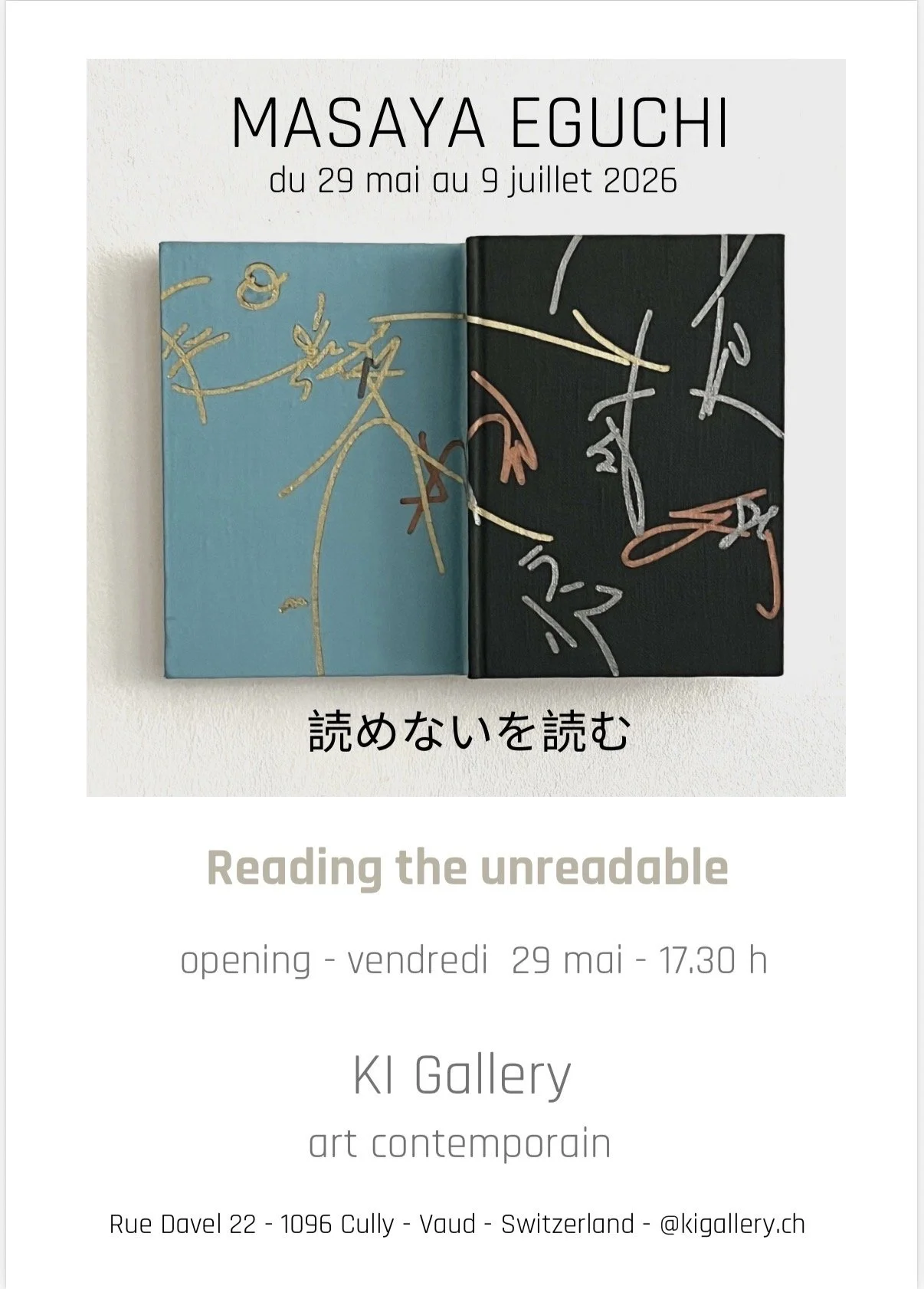
読めないを読む>について
About “Reading the unreadable”
Masaya Eguchi describes this new body of work as an extension of his earlier series Unidentified. This series centres on the very process of perception itself. Composed of intentionally ambiguous linear forms, the works appear almost legible yet never entirely readable; at times they evoke systems of writing, vegetal forms, or living organisms, before dissolving once again into abstraction. Rather than presenting fixed imagery, these works remain suspended in a constant state of visual uncertainty.
When speaking about the origins of this visual language, the artist often refers to his childhood. Raised in close proximity to the practice of calligraphy through his mother, who was herself a calligrapher, Eguchi developed from an early age a sensitivity to the beauty of gesture, rhythm, emptiness, and the balance within written marks. In particular, he recalls being deeply drawn to characters that appear readable yet never fully reveal themselves — forms that suggest meaning while refusing to state it explicitly. Perhaps for this reason, he has never perceived a strict boundary between painting and calligraphy.
In this new series, Eguchi extends these investigations into structures shaped like books. At the same time, the works signal the beginning of a future library project he hopes to develop further. He speaks of a profound fascination with the materiality and physical presence of books — objects whose tactile existence may one day disappear through digitalisation — as well as with the silent and contemplative space of the library itself. For the artist, these belong to the same realm as painting: a space of memory, silence (inner time), and perceptual experience.
Kiki M. Angles
MASAYA EGUCHI - KI Gallery -
Masaya Eguchi is a Japanese artist born in 1970 who currently lives and works in Barcelona. He studied painting at Tama Art University in Tokyo, where he obtained both his BA and MFA during the 1990s. Rooted in a rigorous understanding of pictorial language while remaining deeply experimental in its application, his practice has evolved into a singular investigation of material perception, ambiguity, and spatial experience.
Eguchi’s work questions not only the traditional territory of painting, but also the very conditions through which painting itself is understood — namely its meaning, spatial logic, and relationship to dimensionality. His surfaces refuse to remain confined within the framework of painting as mere image, expanding instead toward an intermediate territory between painting, object, and architectural presence. What initially appears as a flat pictorial surface gradually emerges as a constructed physical body, in which texture, depth, reflection, and shadow become active compositional elements.
In this sense, his practice moves beyond representation itself toward a more fundamental exploration of perception. Matter is no longer treated as a passive support for the image, but rather as a living structure endowed with its own visual and spatial presence. Materials such as wood, minerals, pigments, metallic powders, and metal leaf are not simply employed to produce effects; they become carriers of tension, weight, opacity, and light. The resulting volume is perceived not as sculpture in the conventional sense, but as an unstable condition emerging directly from the surface itself.
Ultimately, Eguchi proposes a form of painting that constantly oscillates between flatness and depth, image and object, presence and disappearance. His work invites the viewer to reconsider how space is experienced visually and physically, suggesting that perception is never fixed, but continuously shaped by movement, light, memory, and distance.
Kiki M. Angles
MASAYA EGUCHI
江口暢彌は1970年に日本で生まれ、現在はバルセロナを拠点に活動するアーティストである。1990年代に東京の多摩美術大学で絵画を学び、学士号および修士号を取得した。絵画言語に対する厳格な理解に根ざしながらも、その実践は常に実験的であり、物質的知覚、曖昧さ、そして空間体験をめぐる独自の探求へと発展してきた。
江口の作品は、絵画の伝統的な領域だけでなく、絵画そのものがどのように理解されるかという条件――すなわち意味、空間的論理、そして次元性との関係――そのものを問い直している。その表面は、単なるイメージとしての絵画の枠組みに留まることを拒み、絵画、オブジェ、建築的存在感の中間領域へと拡張していく。最初は平面的な画面として現れるものが、やがて質感、奥行き、反射、影といった要素が能動的に作用する構築的な身体として立ち現れる。
この意味において、彼の実践は単なる再現を超え、知覚そのものへのより根源的な探求へと向かっている。物質はもはやイメージを支える受動的な支持体ではなく、それ自体が固有の視覚的・空間的存在性を持つ生きた構造として扱われる。木材、鉱石、顔料、金属粉、金属箔といった素材は、単に効果を生み出すための手段ではなく、緊張感、重量、不透明性、光を担う要素となる。そこに現れるヴォリュームは、従来の意味での彫刻ではなく、表面そのものから現れ、不安定な状態として知覚されるのである。
江口は最終的に、平面性と奥行き、イメージとオブジェ、存在と消失のあいだを絶えず往還する絵画のあり方を提示している。彼の作品は、空間がどのように視覚的かつ身体的に経験されるのかを再考するよう観賞者に促し、知覚とは決して固定されたものではなく、動き、光、記憶、そして距離によって絶えず形成され続けるものであることを示唆している。
<読めないを読む>について
江口暢彌は、この新しい作品群を、以前のシリーズ Unidentified の延長線上にあるものとして語っている。このシリーズは、知覚そのもののプロセスを主題とした作品群である。意図的に曖昧な線的フォルムによって構成された作品は、ほとんど読めそうでありながら決して完全には判読できず、時に文字体系や植物、有機的生命体を思わせながら、再び抽象へと溶け込んでいく。固定されたイメージを提示するのではなく、それらの作品は常に視覚的不確かさの状態に留まり続けている。
この視覚言語の起源について、作家はしばしば自身の幼少期に触れる。書家であった母親のもとで書道に親しみながら育った江口は、筆致の美しさ、リズム、余白、そして文字の均衡に対する感覚を幼い頃から自然に身につけていった。とりわけ彼は、「読めそうでありながら完全には読めない文字」に強く惹かれていたという。意味を暗示しながらも、それを決して明確には提示しない形態である。おそらくそのために、彼にとって絵画と書道のあいだに明確な境界は存在しなかった。
今回の新作では、江口はこうした探求を本の形態を持つ構造物へと展開している。それは同時に、彼が今後さらに発展させたいと考えている図書館プロジェクトの始まりでもある。彼は、デジタル化によっていつか失われるかもしれない本という物体の物質性や身体的存在感、さらには図書館という静謐で瞑想的な空間そのものに深い魅力を感じているという。作家にとって、それらは絵画と同じ領域に属している。すなわち、記憶、沈黙(内在的時間)、そして知覚体験の空間なのである。
Written by KIKI M. Angles , translated by Masaya Eguchi

MARI ITO
SOLO EXHIBITION - PETITS DESIRS -
from April 17th to May 27th
Mari Ito (b. 1980, Tokyo), currently based in Barcelona, whose work is distinguished by its joyful energy and vibrant sensibility.
Trained in traditional Japanese painting (Nihonga) at Joshibi University of Art and Design in Tokyo, Ito has developed a practice that bridges Japanese artistic heritage with a contemporary visual language. Her work unfolds primarily on Japanese paper and wood, engaging with techniques and materials deeply rooted in this tradition.
Ito’s imagery draws on floral compositions, a motif strongly embedded in Japanese culture, which she reinterprets as expressive and symbolic forms. Through these compositions, she explores emotional states and inner impulses, often referencing the origins of desire and the complexity of human feeling. Her visual language combines vivid color, delicate line work, and a flattened spatial perspective, creating dynamic yet introspective compositions.
In this new body of work, Ito continues her exploration of the origins of desire, now shifting toward a more intimate approach. Moving away from her characteristic large-scale works, this series presents smaller and more unusual formats that invite a closer, more personal engagement.
Mari ito : Desire in Bloom
Mari Ito (Tokyo, 1980) is a Japanese artist based in Barcelona since 2006. She trained at the Joshibi University of Art and Design, specializing in nihonga, a traditional Japanese painting technique using materials such as washi paper, sumi ink, and natural pigments. Her work fuses this tradition with Western influences, creating a unique visual language.
The central theme of Mari Ito’s work is the exploration of human desire and its origins. Inspired by Sigmund Freud’s psychoanalytic theory, especially the concept of the id, Ito depicts these impulses through images of anthropomorphic flowers and dreamlike compositions. These flowers, often bearing faces or gestures, symbolize repressed emotions and desires—particularly in cultural contexts where their public expression is avoided.
Her work also reflects an animistic worldview, in which each natural element possesses a soul or consciousness. This manifests in representations where plant life comes alive, establishing a dialogue between the human and the natural, inviting the viewer to reflect on the duality of human emotions and the connection between the subconscious and nature. Natural elements are not simply there to be admired; they are alive, they watch us, they interact with us.
Her compositions flow without rigidity, and each element seems to grow organically. In this visual universe, the influence of Catalan modernism is apparent in her appreciation of the organic, the curved, and the vegetal. As in the sinuous forms of Art Nouveau, Ito embraces this sensitivity in a natural dance of organic forms—bridging the symbolism of modernism and Japanese animism, where everything—a flower, an eye, a root—may possess a soul.
This contrast between East and West, between the psychic and the ornamental, between the botanical and the profound, gives her work an ambiguous quality: beautiful, yet charged with a disturbing energy; tender, yet provocative. Mari Ito does not aim to depict desire: she lets it grow, blossom—like a flower in constant transformation.
This allows Ito to speak of desire, the unconscious, of what pulses within us, through a visual language filled with living symbols. Rather than directly representing emotions, she allows them to bloom freely.
Her art invites us to pause, to observe attentively. Sometimes, beauty can be strange, and the strange, deeply human. Ito seems to tell us that our most primal impulses are not far from the delicacy of a flower. One only needs to look with different eyes.
At the intersection of desire (Freud’s id) and the soul of things (animism), her work finds its own voice: intimate, exuberant, colorful, eccentric, yet deeply relatable.
Among her most well-known works is the pictorial intervention Is it spring? in the Universitat metro station in Barcelona, created in 2017. This piece celebrates the arrival of spring and symbolizes rebirth and transformation.
In 2019, Ito presented the exhibition The Garden of Desires of Contemporary Japan in Zaragoza, where she explored these themes through paintings, folding screens, and installations. Her work has been exhibited internationally, noted for its ability to transform the intimate into vibrant images that invite introspection.
KIki M. Angles
個展 — 小さな欲望(Petits Désirs)
2024年4月17日 − 5月27日
マリ・イトウ:咲きゆく欲望
マリ・イトウ(1980年、東京)は、2006年よりバルセロナを拠点に活動する日本人アーティストです。東京の女子美術大学にて日本画を専攻し、和紙、墨、天然顔料などの伝統的な素材と技法を学びました。彼女の作品は、この日本の伝統と西洋的な影響を融合させ、独自の視覚言語を生み出しています。
マリ・イトウの作品の中心にあるのは、人間の欲望とその起源の探求です。Sigmund Freudの精神分析理論、特にイド(id)の概念に着想を得て、イトウはこうした衝動を擬人化された花や夢幻的な構成によって表現しています。顔や身振りを持つ花々は、抑圧された感情や欲望、特にそれらの公的な表現が抑えられがちな文化的文脈における内面を象徴しています。
また彼女の作品は、自然界のあらゆる要素に魂や意識が宿るとするアニミズム的な世界観にも深く根ざしています。植物が生命を帯びるように描かれ、人間と自然との対話が生まれることで、観る者に感情の二面性や無意識と自然とのつながりについての思索を促します。自然は単なる鑑賞対象ではなく、生き、私たちを見つめ、相互に関わる存在として現れます。
彼女の構成は硬直することなく流動的で、それぞれの要素が有機的に成長していくかのようです。この視覚世界には、有機的で曲線的、植物的な要素への関心という点において、カタルーニャ・モダニズムの影響も見て取れます。アール・ヌーヴォーのしなやかな形態と同様に、イトウは有機的なフォルムの自然な動きを受け入れ、日本的アニミズムとモダニズムの象徴性を結びつけています。そこでは、花、目、根といったすべてのものが魂を持ちうる存在となります。
東洋と西洋、精神性と装飾性、植物的なものと深層的なものとの対比は、彼女の作品に曖昧で魅力的な性質を与えています。それは美しくありながらどこか不穏であり、優しさと挑発性を同時に内包しています。マリ・イトウは欲望を描くのではなく、それを育て、咲かせます——絶えず変化し続ける花のように。
このようにして彼女は、欲望や無意識、そして私たちの内側で脈打つものを、生きた象徴に満ちた視覚言語によって表現します。感情を直接的に示すのではなく、それらが自由に開花することを許すのです。
彼女の作品は、立ち止まり、注意深く観ることを私たちに促します。時に美しさは奇妙であり、奇妙さは深く人間的でもあります。イトウは、最も原初的な衝動が花の繊細さと遠く離れてはいないことを示しているのかもしれません。ただ異なる視点で見ることが求められているのです。
欲望(フロイトのイド)と万物の魂(アニミズム)の交差点において、彼女の作品は独自の声を獲得しています。それは親密で、豊かで、色彩にあふれ、時に風変わりでありながら、深く共感を呼び起こします。
代表作のひとつに、2017年にバルセロナの大学駅(Universitat駅)で制作された壁画《Is it spring?》があります。この作品は春の訪れを祝福し、再生と変容を象徴しています。
2019年にはサラゴサにて「現代日本の欲望の庭」展を開催し、絵画、屏風、インスタレーションを通してこれらのテーマを展開しました。彼女の作品は国際的に発表されており、親密な感情を鮮やかなイメージへと昇華し、内
省へと誘う力で注目されています。
Kiki M. Angles
Naotsugu Hashimoto
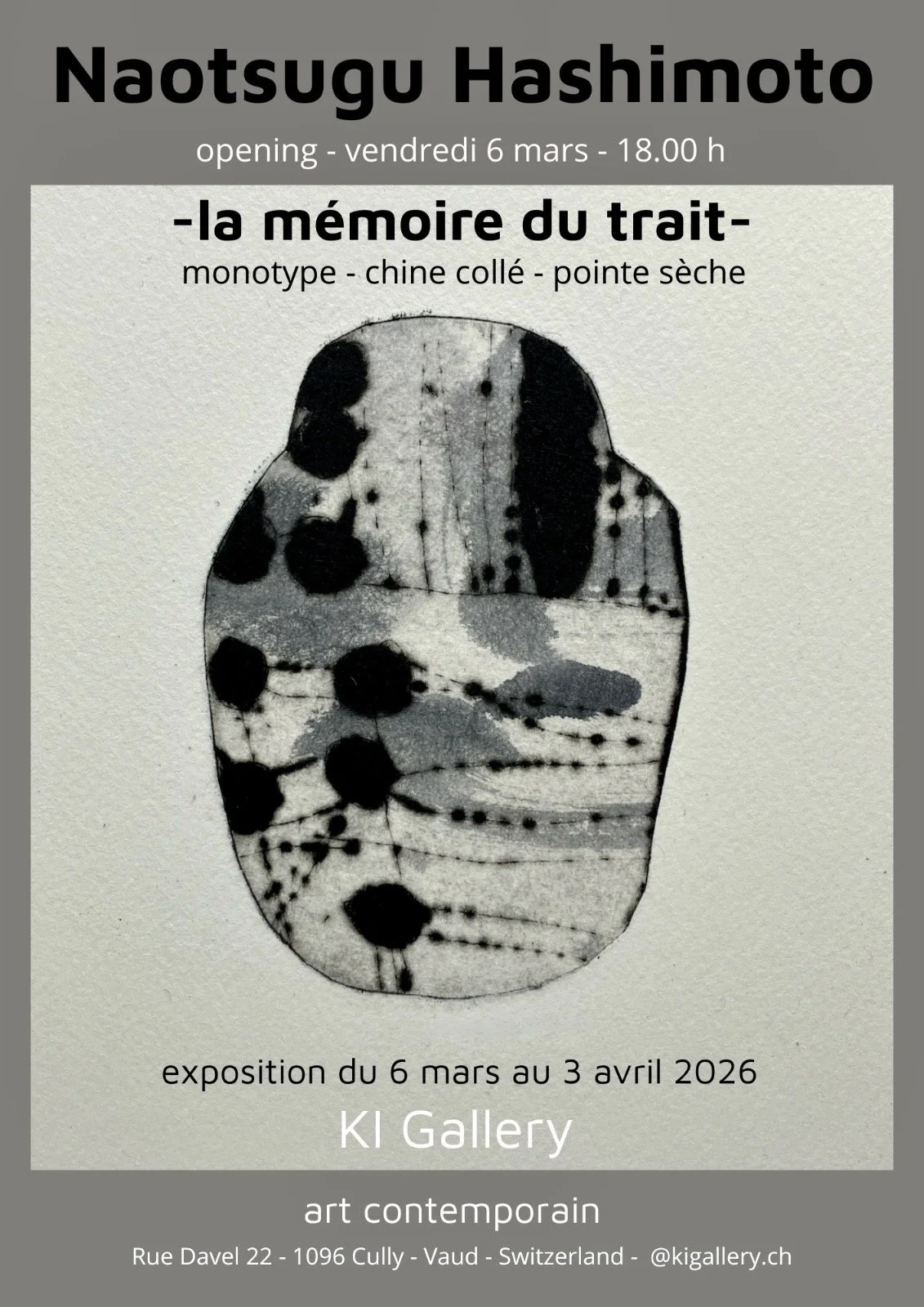
LA MEMOIRE DU TRAIT
The work of NAOTSUGU HASHIMOTO belongs to the field of contemporary printmaking, primarily through the use of drypoint combined with chine-collé. His practice is characterized by a formal economy: few elements, pared-down compositions, and a predominance of black.
His prints are constructed around line and materiality. Drypoint allows him to obtain a vibrating line — at times fragile, at times incisive — that preserves the direct trace of the gesture. Chine-collé introduces an additional dimension of texture and depth, reinforcing the relationship between surface and space.
Although his forms may appear abstract, they do not seek spectacle. Instead, they privilege an inner tension, a subtle balance between presence and emptiness. Black is not merely a color in his work; it becomes density, silence, resonance.
Taken as a whole, his work invites attentive contemplation. Through the apparent simplicity of his compositions, HASHIMOTO explores the depth of the line, the materiality of paper, and the expressive strength of minimal means.
Kiki M. Angles
NAOTSUGU HASHIMOTO の作品は、現代版画の領域に位置づけられ、主にドライポイントとシン・コレ(chine-collé)の技法を用いて制作されています。彼の制作は、要素を最小限に抑えた構成と黒を基調とする画面によって特徴づけられます。
作品は、線と素材性を中心に構築されています。ドライポイントによって生まれる線は、ときに繊細で、ときに鋭く、作家の直接的な身振りの痕跡をとどめています。シン・コレは質感と奥行きを加え、画面の表層と空間との関係をより豊かなものにしています。
その形態は抽象的に見えるかもしれませんが、視覚的な効果を追求するものではありません。むしろ、存在と余白のあいだに生まれる内的な緊張感や、繊細な均衡を大切にしています。ここでの黒は単なる色彩ではなく、密度であり、沈黙であり、響きでもあります。作品全体は、静かで注意深い鑑賞へと鑑賞者を誘います。表面的には簡潔に見える構成のなかで、HASHIMOTO は線の深さ、紙の物質性、そして最小限の手段による表現の力を探求しています。